


HONESTY IS THE ROOT
Quality is always satisfactory
Hotline
400-606-8981
PRODUCT CATEGORY
LATEST NEWS
MORE
PRODUCT DETAILS
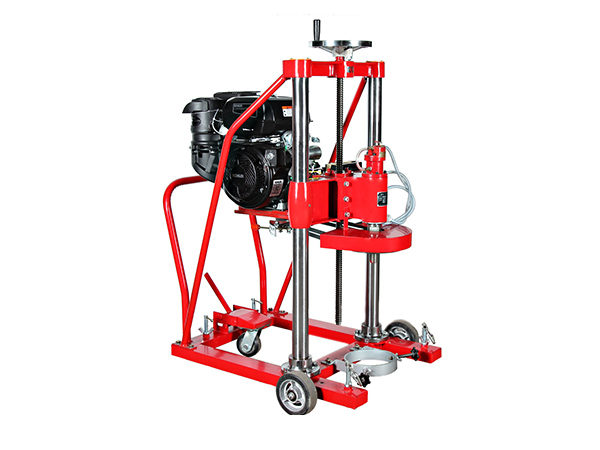
The HZ-20 concrete drilling and coring machine is one of the HZ series diamond engineering drilling machines. It is powered by a gasoline engine (Honda or Yamaha) and has fast starting and stable operation. It is suitable for engineering drilling in places without electricity and larger diameters
1. Main purpose:
The HZ-20 concrete drilling and coring machine adopts cutting technology and is matched with thin-walled diamond drill bits. It is widely used in drilling and coring industries such as engineering construction, municipal engineering, equipment installation engineering, and building quality inspection1、 Core samples are taken from concrete, asphalt pavement, limestone foundations such as highways, airports, ports, and dams for compressive and flexural tests
2、 Install large machinery and equipment by drilling anchor bolt holes
3、 Install bridge handrails and drill holes for traffic safety protective railings
2. Main features:1、 Adopting a double column structure and spiral feeding method, it has good stability and simple and labor-saving operation. Equipped with wheels for easy movement
2、 By using high-speed cutting technology and thin-walled diamond drill bits, high-strength reinforced concrete can be drilled and cut with good drilling efficiency, accurate hole position, smooth hole wall, good hole quality, complete and smooth core sample, low vibration, and no damage to buildings
III. Main Technical Parameters:1、 Large drilling diameter: 200mm
2. Large drilling scale: 700mm (up to 1500mm when using extension rods or core tubes)
3. Output speed: 800-1200 rpm
4. Power: 5.5 horsepower, 9.0 horsepower, 13 horsepower (Honda or Yamaha gasoline engines)
5. Machine weight: 110 kilograms
4. Operation process:
1、 Preparation before use
(1) Add 93 # unleaded gasoline and good quality lubricating oil, and the amount of oil added can be based on the oil dipstick scale
(2) Add lubricating oil to the column and rotate the feed handle and output shaft to check whether the feed and rotation are flexible and excellent (3) Prepare the water source (4) Check if the screws in each part are loose2、 After installing the drill bit into the hole position, lift the three walking wheels and let the base land on the ground. When drilling small holes and the concrete strength is not high, the drilling rig can be fixed by its own weight. If the drilling hole is too large and the weight of the drilling rig cannot stabilize it, heavy objects (such as sandbags, iron blocks, concrete blocks, etc.) can be placed on the chassis to fix it or two expansion bolts and pressure rods (such as channel steel, etc.) can be used to fix the drilling rig. The drilling rig should be firmly fixed and not shaken, otherwise the drilling operation cannot be carried out normally
3、 After completing the above tasks, you can proceed with the drilling operation. Install the drill bit, start the gasoline engine (see the gasoline engine user manual for details), and place the inlet pipe into the water bucket. The water bucket should be raised above the water pump position, and then hold the air pump to suck water into the water pump. After filling the water pump with water, place the water bucket on the ground. Turn up the throttle and start gently shaking the handle to slowly bring the drill bit into contact with the ground. The key to drilling: feed water first and then drill, with a slow feed speed and low drilling pressure. It is strictly prohibited to work without water to avoid burning the drill bit and water seal
4、 Normal drilling
When the hole is drilled to a depth of 2-3 millimeters, normal drilling can be started. At this time, the feeding pressure should be appropriately increased. The key to normal drilling is to maintain moderate and even feeding pressure, and to reduce the feeding pressure when encountering coarse steel bars. To achieve the goal of listening and watching, listen to the sound of the machine to see if it is normal, and check if there is water flowing back (out) from the hole
5、 After the final hole reaches the selected scale, drilling can be stopped. The requirement for stopping drilling is to first turn off the machine and then turn off the water. If it is a deep hole, it is not possible to immediately lift the drill and stop the water supply. Instead, it is necessary to punch the hole with water for a period of time in order to wash away the rock powder inside the hole, in order to prevent the rock powder from settling and burying the drill, which may cause difficulties in core extraction
5. Precautions: When a stuck drill occurs, it is not allowed to use the method of forcibly starting the machine to remove the stuck drill. Instead, manual methods (such as using an extended hand to rotate the drill bit) should be used to remove the stuck drill before restarting the machine2、 When the rock core gets stuck in the drill bit, drilling should be stopped immediately and removed in a timely manner. When removing, only gently tap the steel body of the drill bit with a rubber hammer or cork stick, and repeatedly tap to remove the rock core. It is strictly prohibited to use a hammer to strike the drill bit or rock core, and it is strictly prohibited to insert an iron rod from the back of the drill bit to strike the rock core, in order to avoid damaging the thin-walled drill bit
3、 Before use, carefully read the (gasoline engine user manual)
4. It is strictly prohibited to work without water
6. Repair and Maintenance 1. After the core is taken, the appropriate parts should be wiped clean, dried, and oiled2、 There should be dedicated personnel responsible for the use and maintenance of the machine to maintain its normal operation
3、 Regularly check gasoline and engine oil to prevent short oil from causing damage to the machine and affecting its lifespan
4、 After prolonged or repeated use of the machine, it is necessary to check whether the bolts in each part are loose to prevent any impact or delay in normal use
5、 If the machine is not used for a long time, the gasoline in the carburetor should be drained to prevent the carburetor from being soaked for too long and difficult to start next time
7. Common faults and troubleshooting
Troubleshooting methods
Gasoline engine smoking 1. Excessive engine oil
2. Engine oil entering the combustion chamber 1. Extract some engine oil
2. Remove the spark plug, then pull the starting handle to drain all the engine oil. After inserting the spark plug, start the gasoline engine to idle normally.
The gasoline engine is not powerful. 1. The gasoline rating is not up to the required level.
2. The throttle valve is closed. 1. Replace the gasoline with a different rating.
2. Rotate the governor back to open the throttle valve.
Difficult to start gasoline engine 1. Excessive carbon buildup on spark plugs
2. Aging of spark plugs
3. Failure to close air blocking valve (when cooling) 1. Clean spark plugs
2. Replace with new spark plugs
3. Close air blocking valve
Slow core removal 1. Dull drill bit
2. Belt aging
3. Loose belt
4. Slow speed 1. Replace with new drill bit
2. Replace with new standard angle belt
3. Adjust tightening belt bolt
4. Adjust the throttle to the high-speed position