


HONESTY IS THE ROOT
Quality is always satisfactory
Hotline
400-606-8981
PRODUCT CATEGORY
LATEST NEWS
MORE
PRODUCT DETAILS
1、 Overview
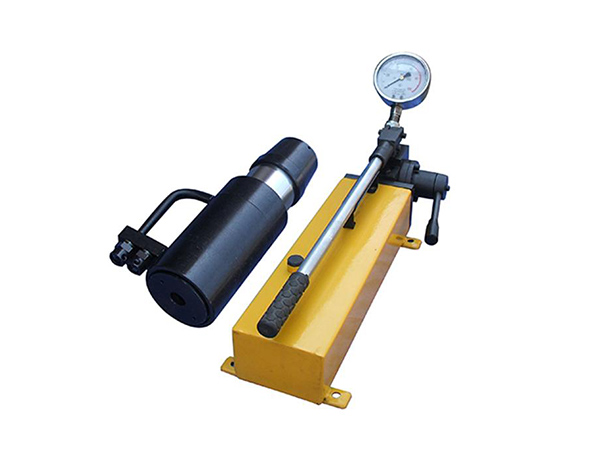
Our company develops and produces the ML series anchor rod tension meter for detecting solid forces such as anchor rods and steel bars. It is one of the instruments required for quality inspection of anchor rod support engineering
The ML series anchor rod tension gauge consists of a hand pump, hydraulic cylinder, pressure gauge, and high-pressure rubber hose. The ML-200/300 manual pressure pump is designed with high and low pressure dual diameter plunger, with high pressure effect. The pump body is made of cast steel and has a long service life. The hydraulic steel is a hollow self resetting type, and the ML-200/300 is equipped with a handle and can be connected to high-pressure rubber hoses through a speed suitable joint. This series of tension gauges has a compact structure, is easy to carry, has a small volume, and is lightweight The manual pump of the tensile tester can also be used as a power source for general low flow high-pressure oilII. Main Technical Parameters
ML-150 Anchor Rod Tensile Gauge
1. Hand pump: (1) High working pressure: 63Mpa (2) Piston diameter: 10mm (3) Mass: 6Kg
2. Jack: (1) Working capacity: 150KN (2) Tensile stroke: 40mm (3) Mass: 4Kg
ML-200 Anchor Rod Tensile Gauge
1. Hand pump: (1) High working pressure: 63Mpa (2) Piston diameter: 10mm (low pressure) 28mm (high pressure)
(3) Mass: 10Kg
2. Jack: (1) Working capacity: 200KN (2) Tensile stroke: 40mm (3) Weight: 8Kg
ML-300 anchor rod tension meter
1. Hand pump: (1) High working pressure: 63 Mpa (2) Piston diameter: 10mm (low pressure) 28mm (high pressure)
(3) Weight: 11Kg
2. Jack: (1) Working capacity: 300KN (2) Tension stroke: 60mm (3) Weight: 13Kg
ML-500 anchor rod tension gauge
1. Hand pump: (1) High working pressure: 63 Mpa (2) Piston diameter: 10mm (low pressure) 28mm (high pressure)
(3) Weight: 15Kg
2. Jack: (1) Working capacity: 500KN (2) Tension stroke: 80mm (3) Weight: 16Kg
ML-1000 anchor rod tension gauge
1. Hand pump: (1) High working pressure: 63 Mpa (2) Piston diameter: 10mm (low pressure) 28mm (high pressure)
(3) Mass: 20Kg
2. Jack: (1) Working capacity: 1000KN (2) Tensile stroke: 80mm (3) Mass: 50Kg
3. Structural features and operating steps:
The ML series anchor rod tension gauge consists of an oil injection valve, an oil storage cylinder, a pump body, an unloading valve, a pointer gauge, an oil pipe, a speed suitable joint, and a hydraulic cylinderOperation steps:
1、 Check the oil level. If the hydraulic cylinder piston is not fully retracted into the cylinder body, it should first be connected to the hand pump through an oil pipe, and the unloading valve on the pump body should be loosened counterclockwise to allow the hydraulic oil in the jack to return to the oil storage cylinder of the hand pump
Unscrew the oil injection valve and check the oil level. If the oil is not enough, you can add N46 wear-resistant (based on actual reports) hydraulic oil or 20 oil2、 After the hydraulic system is assembled, there is often air mixed in the oil storage tank, oil pipe, and hydraulic cylinder. In order to ensure the normal operation of the hydraulic system, this air needs to be discharged. The method is to place the manual pump slightly higher than the hydraulic cylinder, press the manual pump to extend the hydraulic cylinder piston, then open the unloading valve to retract the piston, and repeat this process several times. When necessary, the oil injection valve can be opened to remove the air inside the oil storage tank
3、 Check the anchor rod
Connect the oil pipe to the jack and perform oil quantity, exhaust, and pressure gauge checks according to the requirements of items 1 and 2 above
Screw the pull rod (please specify the specifications when ordering or prepare according to the actual testing situation) to the end of the anchor rod. If the outer diameter of the internal thread of the pull rod is larger than the center hole of the oil cylinder, an extension sleeve can be added at the bottom of the oil cylinder, and then the hydraulic cylinder can be fitted (with the piston end facing outward), and then the nut should be tightened and the relief valve should be tightened clockwise.
Press the handle of the oil pump evenly, without applying too much force. When the reading on the pressure gauge reaches the required level, stop pressurizing Note that the manual pump needs to be placed horizontally for operation. After the inspection is completed, the oil drain valve should be loosened counterclockwise to make the pressure gauge read zero, and then all components should be removed from the anchor rod When the outer end of the anchor rod or steel bar being tested does not have threads and cannot be connected to the tension rod, MJ-1 type ¢ 6-38 anchors of different specifications produced by our company can be selectedIV. Precautions
1. The tension gauge should not be overloaded, otherwise it may cause long-term damage.
2、 The hydraulic pump should be kept clean. After using the oil cylinder, the piston should be retracted and oil should be added to the inside and outside of the piston rod frequently
3、 When the oil cylinder is working, the bottom should be placed flat and stable, and subjected to vertical force. Do not work beyond the scheduled time
4、 The hydraulic oil should be filled clean
5、 The pressure on the tested anchor rod can be read on the pressure gauge (megapascal Mpa) and the corresponding total tension (KN) can be found in the conversion table. The digital display meter can directly read the tension value
V. Common Malfunctions and Troubleshooting Methods
Fault Phenomena and Causes
No pressure display on the pressure gauge, insufficient oil in the oil cylinder, open the oil injection valve and add oil
The relief valve is not tightened clockwise
The joint is leaking oil and tightened
The manual pump is not placed horizontally and the water is drained before applying pressure
The pressure gauge is damaged and removed for inspection or calibration
If the pressure cannot be reached, the manual pump is lacking oil and add oil
Check the joint and sealing ring for oil leakage
Replace the oil if the oil quality is incorrect or dirty
Hydraulic cylinder The sealing ring inside the oil leaking cylinder is damaged and needs to be replaced. The pressure gauge pointer has dropped significantly, and there is severe oil leakage at the joint. Tighten or replace the sealing ring if it fails. If the oil quality is too dirty, clean the oil cylinder, pump body, and oil pipe with kerosene Oil change after oil cylinder
Each one-way valve in the pump body has poor sealing and needs to be sent back to the factory for maintenance
The pressure gauge pointer moves, but the hydraulic cylinder has no pressure oil pipe blockage and the oil pipe is unblocked
The joint is blocked and cleaned.