


HONESTY IS THE ROOT
Quality is always satisfactory
Hotline
400-606-8981
PRODUCT CATEGORY
LATEST NEWS
MORE
PRODUCT DETAILS
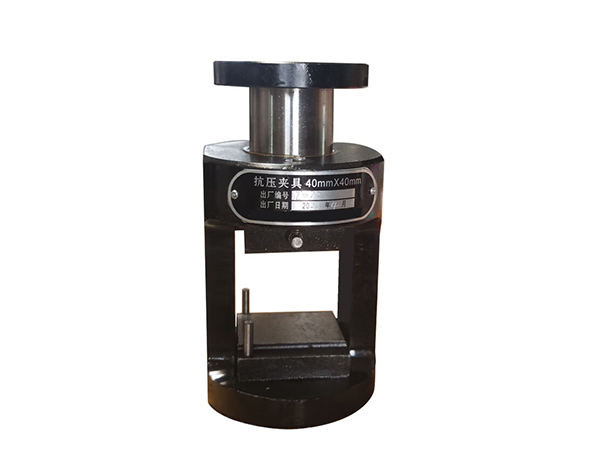
1、 Purpose: The 40 * 40 cement compression fixture is a supporting instrument designed for the Chinese national standard GB/T17671-1999 "Method for Testing the Strength of Cement Mortar (ISO Method)". This instrument complies with the building materials industry standard JC/T638-1997 and is equivalent to the ISO679:1989 (E) 4.2.8 standard, used for cement compressive strength testing
2. Main technical parameters:1. The length of the upper and lower pressure plates is 40 ± 0.1mm2. The external dimensions of the fixture are φ 100 × 165mm3. The total weight of the fixture is about 5kg
3. Structure: (see figure)
This fixture has a sturdy clamp (1), and a lower pressure plate (2) is fixed in the lower hole of the clamp (1), which is used to hold cement test blocks.
There are two positioning pins (3) installed on the lower pressure plate (2) for locating the test block. Clamp the upper hole tightly with a liner (7), which is equipped with an upper ball seat (10). The upper ball seat (10) can freely move and rotate axially within the hole. The upper pressure plate (4) is connected to each other by a hanging spring pin (5), a tension spring (6), a nut (8), and a spherical cylindrical head screw (9). It is hung on the clamp body (1) and contacts the upper ball seat (10) on the spherical surface to protect the upper and lower planes of the test block from being parallel. When the upper and lower planes of the test block are not parallel, the upper pressure plate can rotate automatically, so that its plane is in close contact with the upper plane of the test block. A guide circular pin is installed on one side of the upper pressure plate (4) and inserted into the long groove in the middle of the clamp body (1) to prevent the upper pressure plate (4) from rotating in the horizontal plane. The height position of the upper pressure plate can be adjusted by rotating the spherical cylindrical head screw (9). The distance between the upper and lower pressure plates is generally adjusted to 45-50. When the test block is pressurized, the upper ball seat (10) moves downward under force, causing the upper pressure plate (4) to approach the upper plane of the test block. After unloading, due to the action of the tension spring (6), the upper pressure plate (4) can automatically reset
4. Usage and Maintenance:This fixture is suitable for any type of pressure testing machine. When using it, the fixture should be placed on the lower pressure plate of the pressure testing machine, positioned by the bottom of the fixture with a diameter of 8 holes to align with the center position. Then, the upper and lower pressure plate surfaces should be wiped clean, and a cement test block should be placed. The wider side of the test block should be placed against the positioning pin (3). Adjust the upper pressure plate of the pressure testing machine to contact the upper surface of the upper ball seat (10) of the fixture, and then apply pressure. Record the reading unit of the pressure testing machine when the test block is crushed N, Dividing by the area of the test block (40 × 40=1600mm2) can easily determine the unit of compressive strength: MPa。
V. Annotations
1. Once the compression fixture is verified by the National Building Materials Institute, it can be used as a standard compression fixture for comparative inspection.
2. Standard test blocks are matched with standard compression fixtures, and users can place separate orders upon request