


HONESTY IS THE ROOT
Quality is always satisfactory
Hotline
400-606-8981
PRODUCT CATEGORY
LATEST NEWS
MORE
PRODUCT DETAILS
1、 Overview:
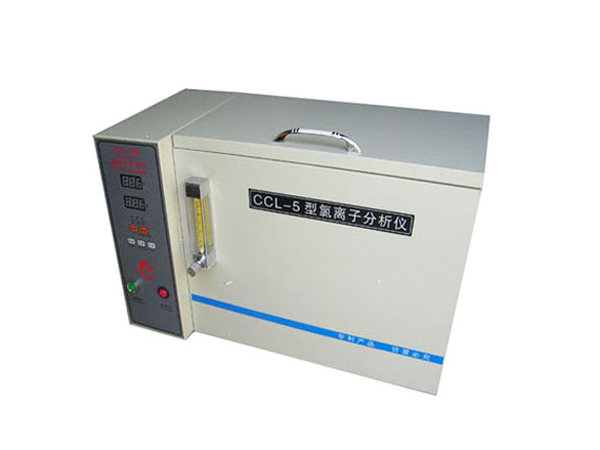
The new standard for General Portland Cement was released and implemented in 2007, which will replace the three standards GB175, GB1344, and GB12958. The new standard for General Portland Cement stipulates a mandatory clause that the chloride ion content should not exceed 0.06%. In response, our company has manufactured and produced the CCL-5 chloride ion analyzer to meet the requirements of the new standard II. Main features of CCL-5 chloride ion analyzer:1、 The analysis speed is appropriate, and the determination of a single sample can be completed within 10 minutes
2、 Good analysis accuracy and analysis result deviation less than the standard required error
3、 Widely applicable, it can be used for the determination of cement products, semi-finished products, and raw materials, as well as for the determination of cement and concrete without additives
4、 It can also be used for the determination of chlorine in cement and other raw materials
III. Technical parameters of chloride ion analyzer:1、 Power Supply: AC220V
2、 Heating power: 1000W
3. Air pump power: 12W
4. Temperature control accuracy: ± 0.2%
5. Timing accuracy: ± 0.1%
6. Distillation time: 10-15 minutes
7. Temperature setting: 250-260 ℃
8. Weight: 25KG
4. Accessories include: 1 bottle of cement chlorine content comparison sample, 1 bottle of nitric acid, 1 bottle of diphenylazocarbazide indicator, 2 snake shaped condenser tubes, 2 gas washing bottles, and 4 quartz tubes
Attachment: Chemical Analysis Method for Chloride Ion Analyzer in Cement Raw Materials
1 Scope of Application
This standard specifies the chemical analysis method for determining chloride ions in cement raw materials by phosphoric acid distillation mercuric salt titration.
This standard is applicable to cement raw materials and other materials designated to use this standard2 Normative References
The clauses in the following documents become clauses of this standard by reference.
. Any referenced document marked with a date shall not be subject to any subsequent amendments (excluding errata) or revisions to this standard. However, parties to agreements based on this standard are encouraged to explore the possibility of using new versions of these documents. Any referenced document without a date shall apply to the new version of this standardGB/T2007.1 General rules for sampling and preparation of bulk mineral products, manual sampling
GB/T6682 Specification and test methods for laboratory water for analysis
3 Basic requirements for testing
3.1 Number of tests
The number of tests for each measurement is specified as two, and the average of the two tests is used to represent the measurement result.
3.2 Representation of Mass, Volume, Titration, and Results Use "grams (g)" to represent mass, accurate to 0.0001g. The volume of a burette is expressed in milliliters (ml), accurate to 0.05ml. The unit of titration is expressed in milligrams per milliliter (mg/ml), and after rounding, the effective number is retained to three digits3.3 Blank Test
Use the same amount of reagent, without adding the sample, and conduct the test according to the same measurement steps. When calculating, deduct the blank test value from the measurement result.
Method Summary
Using a prescribed distillation apparatus, the sample is decomposed with hydrogen peroxide and phosphoric acid at a temperature of 250 ℃ to 260 ℃, and purified air is used as a carrier for distillation and separation of chloride ions. Dilute nitric acid is used as the absorbing liquid, and after distillation for 10-15 minutes, the condenser tube and its lower end in the conical flask are purged with ethanol. The amount of ethanol added is 75% (volume fraction) or more.
. At around pH 3.5, using diphenylazocarbazide as an indicator, titrate with mercury nitrate standard titration solution5 Reagents and Materials
Unless otherwise specified, the reagents used should not be lower than analytical grade.
. The reagents used for calibration and preparation of standard solutions should be reference reagents. The water used should comply with the requirements of word-of-mouth water specified in GB/T6682 The density of commercially available concentrated liquid reagents listed in this standard refers to the density at 20 ℃, measured in grams per cubic centimeter (g/cm3) 5.1 Nitric acid (HNO3), ρ=1.39g/cm3~1.41g/cm3, 65%~68% (mass fraction) 5.2 Phosphoric acid (H3PO4), 85% (mass fraction) 5.3 Ethanol (C2H5OH), 90% (volume fraction) or anhydrous ethanol 5.4 Hydrogen peroxide (H2O2), 30% (mass fraction) 5.5 Sodium hydroxide (NaOH) solution [C (NaOH)=0.5mol/L]Dissolve 2g of sodium hydroxide in 100mL of water
5.6 Nitric acid solution [C (HNO3)=0.5mol/L]Take 3mL of nitric acid (5.1) and dilute with water to 100mL
5.7 Chloride ion standard solution
Accurately weigh 0.3297g of sodium chloride that has been dried at 105 ℃ -110 ℃ for 2 hours, dissolve it in a small amount of water, and then transfer it into a 1L volumetric flask. Dilute with water to the mark and shake well.
. This solution contains 0.2mg of chloride ions in 1mL Take 50.00ml of the above solution and inject it into a 250ml volumetric flask. Dilute with water to the mark and shake well. This solution contains 0.04mg of chloride ions in 1mL5.8 Mercury Nitrate Standard Titration Solution [C (Hg (NO3) 2)=0.001mol/L]
5.8.1 Preparation of Mercury Nitrate Standard Titration Solution [C (Hg (NO3) 2)=0.001mol/L]
Weigh 0.34g of mercury nitrate [Hg (NO3) 2 · 1/2H2O], dissolve it in 10ml of nitric acid, transfer it into a 1L volumetric flask, dilute with water to the mark, and shake well.
5.8.2 Calibration of Mercury Nitrate Standard Titration Solution [C (Hg (NO3) 2)=0.001mol/L]
Accurately add 5.00mL of 0.04mg/mL chloride ion standard solution to a 50mL conical flask using a burette, add 20mL of ethanol and 1-2 drops of bromophenol blue indicator, adjust the solution to blue with sodium hydroxide solution, then adjust the solution to just yellow with nitric acid, add an excess of 1 drop (pH about 3.5), add 10 drops of diphenylazocarbazide indicator, and titrate with mercury nitrate standard titration solution until cherry red appears.
Simultaneously conduct blank experiments. Use the same amount of reagent, without adding chloride ion standard solution, and conduct the experiment according to the same measurement steps The titration degree of mercury nitrate standard titration solution for chloride ions is calculated according to equation (1):TC1==...... (1)
In the equation:
Tc1- Titration degree of mercury nitrate standard titration solution for chloride ions, in milligrams per milliliter (mg/mL)
V2- the volume of mercury nitrate standard titration solution consumed during calibration, in milliliters (mL) V1- The volume of mercury nitrate standard titration solution consumed in the blank test, measured in milliliters (mL)0.04- Concentration of chloride ion standard solution, in milligrams per milliliter (mg/mL)
5.00- Volume of chloride ion standard solution added, in milliliters (mL)5.9 Mercury Nitrate Standard Titration Solution [C (Hg (NO3) 2)=0.005mol/L]
5.9.1 Preparation of Mercury Nitrate Standard Titration Solution [C (Hg (NO3) 2)=0.005mol/L]
Weigh 1.67g of mercury nitrate [Hg (NO3) 2 · 1/2H2O], dissolve it in 10mL of nitric acid (5.6), transfer it into a 1L volumetric flask, dilute with water to the mark, and shake well.
5.9.2 Calibration of Mercury Nitrate Standard Titration Solution [C (Hg (NO3) 2)=0.005mol/L]
Accurately add 7.00mL of 0.2mg/mL chloride ion standard solution (5.7) into a 50mL conical flask using a burette, and follow the steps in 5.8.2
The titration degree of mercury nitrate standard titration solution for chloride ions is calculated according to equation (2):TC1==...... (2)
In the equation:
Tc1- milligrams of chloride ions per milliliter of mercury nitrate standard titration solution V4- Volume of mercury nitrate standard titration solution consumed during calibration, in milliliters (mL) V3- The volume of mercury nitrate standard titration solution consumed in the blank test, measured in milliliters (mL)0.2- Concentration of chloride ion standard solution, in milligrams per milliliter (mg/mL)
7.00- Volume of chloride ion standard solution added, in milliliters (mL)5.10 Silver nitrate solution 5g/L
Dissolve 5g of silver nitrate (AgNO3) in 1L of water.
5.11 Bromophenol Blue Indicator Solution (1g/l) Dissolve 0.1g Bromophenol Blue in 100 mL of ethanol (1-4) 5.12 Diphenylazocarbazide Solution (10g/L)Dissolve 1g of Diphenylazocarbazide in 100mL of ethanol (5.3)
Chloride ion analyzer instruments and equipment
6.1 Balance
Accurate to 0.0001g.
6.2 Glass volumetric vessels burette, volumetric flask, pipette, weighing bottle 6.3 Chlorine Distillation Device